Ignition Architecture — 2026
The Permanent Moon Base
$20 billion. Three phases. One goal: a continuously inhabited outpost at the lunar South Pole — humanity's first permanent home beyond Earth.
$20B
Reallocated over 7 years for Moon Base
$93B
Total program cost through 2025
3
Build phases to permanent habitation
2026
Year Ignition restructure launched
Build Strategy
Three Phases, One Base
NASA's Ignition plan maps a deliberate, risk-reducing path from initial testing to permanent human habitation.
Build / Test / Learn
Initial exploration and validation — CLPS robotic landers scout the terrain, drill for water ice, and map resources at the South Pole. No crewed visits yet. Every robotic mission reduces risk for the astronauts who follow.
- CLPS robotic lander deliveries (Intuitive Machines IM-2 "Athena")
- PRIME-1 ice-mining drill and mass spectrometer for water ice detection
- Uncrewed Lunar Terrain Vehicles (LTVs) mapping terrain
- Resource surveys: hydrogen abundance, thermal maps, slope assessments
Establish Early Infrastructure
Permanent surface systems begin arriving. The nuclear power reactor is deployed, pressurized mobility is established, and early habitation elements are placed — all before extended crew stays. This phase transforms the South Pole from a landing target into a functional work site.
- Space Reactor-1 (SR-1) Freedom nuclear fission reactor deployed
- JAXA Pressurized Rover for extended surface operations
- Canadian Lunar Utility Vehicle for cargo and base maintenance
- First permanent surface habitation elements deployed
Enable Long-Duration Human Presence
The Moon Base becomes permanently inhabited. Astronauts live and work for weeks at a time, conducting deep science, extracting water ice for propellant, and running systems that will be inherited by Mars-bound missions. The Moon stops being a destination and becomes humanity's first off-world home.
- Multi-Purpose Habitation (MPH) module — Thales Alenia Space / ASI
- Full power grid, life support, and high-bandwidth communications
- In-situ resource utilization (ISRU) — water ice extraction & electrolysis
- Mars mission preparation: nuclear-electric propulsion testing at the base
Surface Infrastructure
The Building Blocks
Rovers, habitats, landers, and a nuclear reactor — the hardware that will make the Moon Base work.
IM-2 "Athena" CLPS Lander
Intuitive Machines (CLPS)
An uncrewed commercial lander that delivered PRIME-1 to the lunar South Pole in early 2025 — an ice-mining drill and mass spectrometer designed to detect and quantify the water ice that will power the Moon Base and future Mars missions.
Multi-Purpose Habitation Module
ASI · Thales Alenia Space (Italy)
The Moon Base's primary permanent shelter — designed to withstand extreme temperatures from +130°C to -170°C, continuous radiation exposure, and abrasive lunar dust for a minimum of 10 years. It will be humanity's first permanent address beyond Earth.
Pressurized Rover
JAXA (Japan)
A mobile habitat on wheels — two astronauts can explore tens of kilometers from the base without spacesuits inside the rover's pressurized cabin, dramatically extending the range and duration of surface science and resource operations.
SR-1 Freedom Nuclear Reactor
NASA Fission Surface Power
A nuclear fission reactor that will power the Moon Base through the 14-day lunar night — a period when solar panels generate nothing. SR-1 also validates the nuclear power and propulsion technology that future crewed Mars missions will depend on.
Lunar Utility Vehicle (LUV)
CSA (Canada)
Canada's uncrewed surface vehicle for cargo logistics, equipment repositioning, and base maintenance at the South Pole outpost — freeing astronaut EVA time for science rather than logistics.
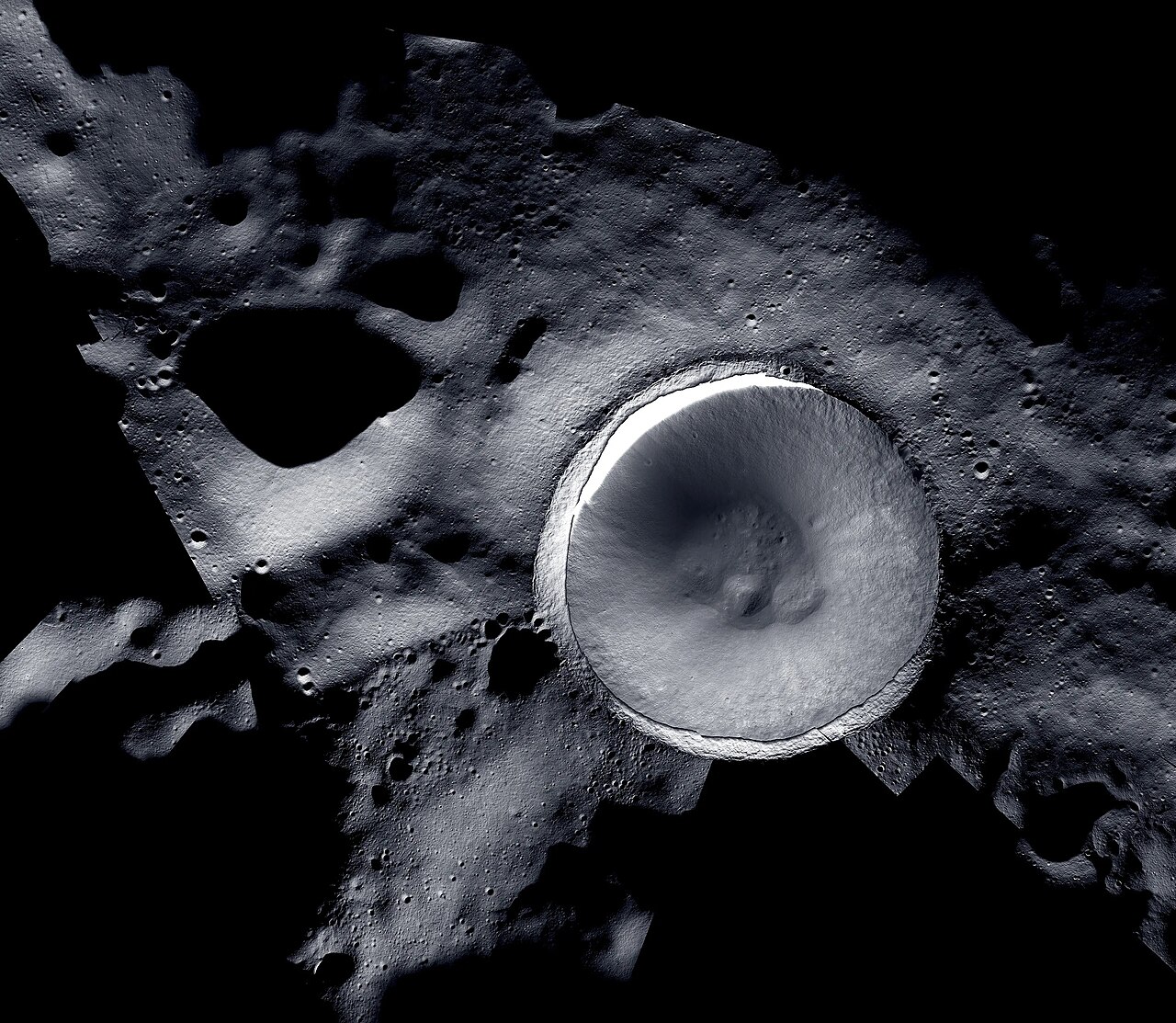
NASA LRO / LROC · Shackleton Crater, Lunar South Pole
Why the South Pole?
Shackleton Crater and its neighbors at the lunar South Pole sit at the intersection of two extraordinary advantages — making this the only viable location for a permanent human outpost on the Moon.
Permanently Shadowed Craters
Shackleton's floor never sees sunlight. Temperatures drop to -183°C, preserving billions of tons of water ice deposited over billions of years — critical for drinking water, oxygen production, and rocket propellant.
Near-Constant Sunlight
Peaks of Eternal Light on crater rims near the South Pole receive sunlight for up to 89% of the lunar year, providing near-continuous solar power — a stark contrast to everywhere else on the Moon.
Mars Fuel Depot
Water ice can be split into liquid hydrogen and liquid oxygen via electrolysis — the propellants used by modern rockets. The Moon Base will produce fuel for missions to Mars and beyond.